
Roshni speaks to Paige Lindenberg, Marketing Manager- Shelby SA and racing driver at Lindenberg Racing. Paige shares how she stays on track in motorsport, marketing and motherhood.
Listen on YouTube and Apple Podcast.
Follow Lift As We Rise - subscribe to the StratConnect channel.
Roshni Gajjar speaks to Franco Chiocchetti, Founder and CEO, RaceOn - a performance engineering company behind championship winning teams in motorsport.
Listen on YouTube and Apple Podcast.
Follow Lift As We Rise - subscribe to the StratConnect channel.
Future Ones is "S'porting STEM Success" at the inaugural Speed Classic Cape Town, happening six decades after the 1962 Camps Bay Hillclimb. In what promises to be a spectacular shootout on 25 and 26 October 2025, motoring and motorsport fans will be treated to the speedy parade of classic cars on Saturday and the race for King (or Queen) of the (Table) Mountain on Sunday. The grid of competitors includes Jan Lammers, a former Formula One driver and Le Mans winner, along with a line up of experienced South African contenders.

Science, Technology, Engineering, Maths and Art principles (STEM and STEAM) underpin car and track design - this event will be a test of engineering excellence, risk management and precision teamwork, on track, along the track and at race control. The 1.8km route has been astutely prepared along the spectacular Philip Kgosana Drive, formely De Waal Drive, starting on the city side and turning around at the Walmer Estate end. Fans get to watch the revving action, from the general access areas, the reserved-seating grandstand, the VIP hospitality lounge and the fan zones. Route design, track safety and logistics have required meticulous planning by the organisers, in close collaboration with the City of Cape Town.

“There is nothing that has as much variety and is as accessible, where you will be that close to the track. Spectators will be only a few metres away from cars that could potentially reach an eye-watering 300km/h. You just do not get that in any other form of motorsport.”
- Garth Mackintosh, event co-founder.
Supported by Motorsport South Africa and the deeply rooted motoring community in the region, the Speed Classic Cape Town further boosts the investment case for short, sharp racing in the Western Cape, following the long-running Knysna Simola Hillclimb. Other major events hosted include the Cape Town e-prix (FIA, Formula E) in 2023 and the Cape Town WRX (FIA, World Rallycross) which has been hosted at Killarney International Raceway intermittently since 2017.

“We are proud to support the Speed Classic Cape Town and as a city we love to host world class events. I believe this race has the potential to grow into a real mainstay event in Cape Town and become a prestigious occasion that will bring visitors from around the world and showcase our city globally.”
- Geordin Hill-Lewis, Executive Mayor of Cape Town.
Economic and environmental sustainability are key success factors to keep next generation motorsport fuelled responsibly. Event-specific Supplementary Regulations govern fair play for all competitors over race weekend. This is where STEM and STEAM professionals can play their part to help future-proof motorsport - Future Ones influences and enables just that, in motorsport and allied industries. Follow our blog for more insights as this event grows.
To the passionate fans following on social media - keep your motorsport posts and comments kind.
Future Ones is a not-for-profit that fuels "Pupil-to-Pinnacle" success in motorsport and allied industries. Driven in partnership with QFinsoft, an Ansys channel partner in South Africa and S2L, a digital literacy initiative pioneered by Mobilearn Africa.
Meet Dominic Illenberger, a Performance and Support Engineer at Hyundai Motorsport. In the first year of joining, his applied engineering skills and focussed committment contributed towards securing the 2022 FIA World Touring Car Cup (WTCR) double title for team Elantra N TCR and driver, Mikel Azcona.

Dominic's pupil-to-pinnacle success story started during his school days at St Dominic’s Priory School in Port Elizabeth, Nelson Mandela Bay, a major hub for South Africa's automotive industry. Safe to say that sharing a name with his school’s patron saint was more a perfect coincidence, than an engineered Illenberger strategy!
On track, trackside and beyond, Dominic applies his high-performance expertise to optimise race performance. His personal passion for motorsport experiences, travel and photography is fuelled through his business, DCI Media - a sweet spot that enables the expression of his love for creating visual art through a camera, with his precision-based Science, Technology, Engineering and Mathematics (STEM) career. In this way, STEM meets STEAM (STEM plus Art) and ikigai is found.

“Seize the moment, embrace the tools we now have to
push the boundaries of what’s possible.” – Dominic Illenberger
How Dominic got involved in motorsport STEM
I’ve always been involved in motorsport — it’s something deeply ingrained in my childhood and a passion I live and breathe every day. I’ve always found joy in understanding how things work, from the inner mechanics of machines to the processes that make them perform at their best. That curiosity pushed me deeper into wanting to understand aspects of STEM. Working in this field felt like the most natural path for me and ultimately laid the foundation for my career in motorsport.
What STEM meant as a pupil and what it means now as a professional
As a pupil, STEM honestly didn’t mean very much to me until the later years of school — probably around Grade 11, when it became real that I needed to start focusing on my future. At that stage, I was more interested in doing exciting things with my friends, like taking part in motorsport, than in sitting down and learning STEM.
But as I matured, I discovered a profound love for STEM and the beauty of how it all works. There’s something truly inspiring about exploring the findings and theories developed over centuries of human progress — from mathematics to engineering — and realising just how much we’ve already achieved as a species.
And now, working in the STEM field, it’s an absolute joy to take that knowledge and apply it: solving complex problems, pushing the boundaries of human performance, and seeing just how far we can go with the incredible solutions that STEM helps to unlock.
Navigating some of the challenges in successfully studying STEM
It was all a struggle (he laughs). But anything worthwhile in life is a struggle — and that’s exactly what makes it so rewarding. How did I overcome them? Hard work and daily grind. It’s simple - what you put in, is generally what you get out.
Key learnings that he applies today
I believe school and university aren’t just about the knowledge you pick up in lectures. What they really teach you are the tools: how to think critically, solve problems, manage pressure, and adapt. Those skills are what truly prepare you for the challenges you’ll face in your job — and they’re the same tools I use every day.
What can be done to prepare school pupils to excel in their STEM studies and careers
I’d hate to just say “work hard,” even though that’s partly true. What really makes the difference is finding the passion within yourself and discovering the niche of STEM that truly excites you. Once you connect with that interest, putting in the grind becomes much easier — and with patience, the rest will fall into place.
A typical work week and percentage of STEM application
A typical work week can look very different depending on the stage of the season. Sometimes it means traveling across the globe, other times it’s long days at the racetrack, and at other times it’s being in the office or workshop focused on research and development. When I think about it, STEM plays a surprisingly high role throughout all of this. It creeps into nearly everything I do — from data analysis to problem solving. If I had to put a number on it, I’d estimate around 65%.
Top three success criteria for teamwork
1. Foster a no-blame culture — focus on solutions, not pointing fingers.
2. Develop a thick skin and don’t take things personally; pressure is part of the sport.
3. Stay humble and never stop learning — motorsport evolves constantly, and so should we.
The key success factor driving his pupil-to-pinnacle story
A lot of sacrifice during university, combined with finding a real passion that I truly live and breathe. Once I discovered that, there was nothing else I was willing to settle for — it became the driving force behind my journey.
Dominic's vision for bright, young STEM/STEAM minds on the African continent
We’re living in a truly unique time where we have access to an incredible amount of information and tools, just a few clicks away – it’s unbelievable and profound. Technology has levelled the playing field across the globe in a way that has never been possible before. For young STEM minds in Africa, my vision is to see this access turned into opportunity — to drive innovation, solve local challenges, and showcase the talent and creativity the continent has to offer. I believe that if you find the right passion and motivation, the potential is truly unknown. People often say, “the sky is the limit”. I don’t think there is a limit — and that is beautifully exciting.

FIA Media, Paris | #UnitedAgainstOnlineAbuse
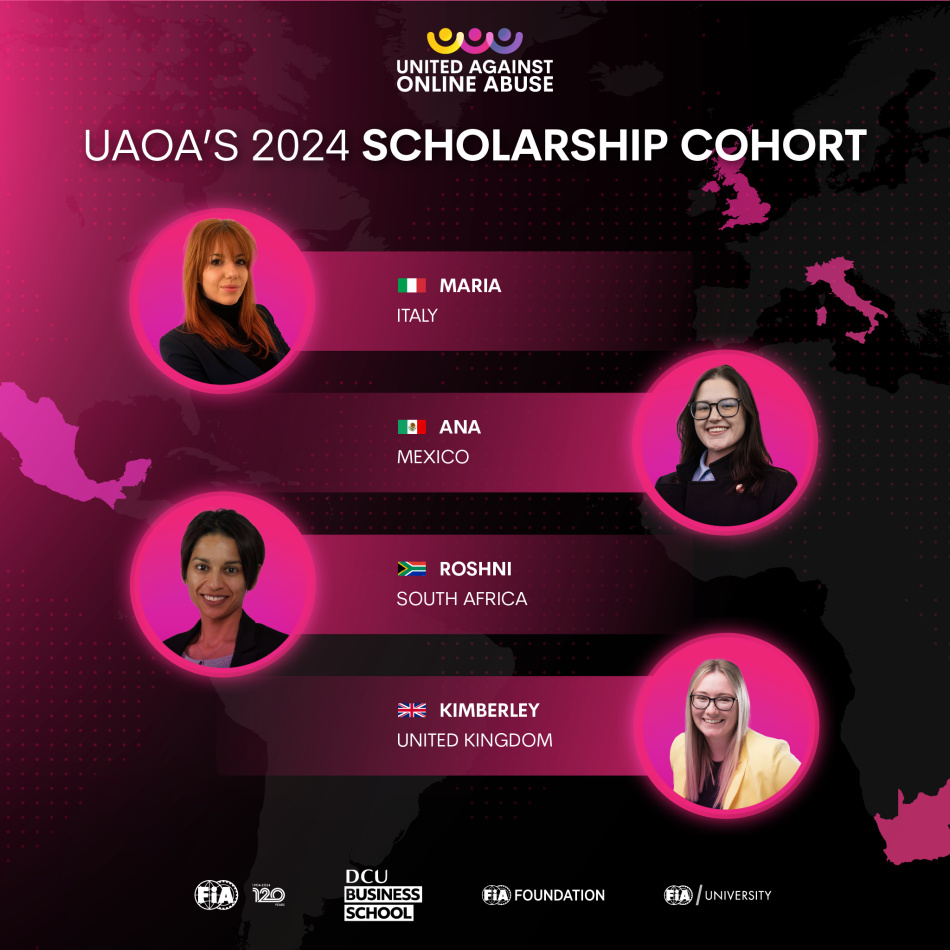
The FIA-led United Against Online Abuse (UAOA) campaign has announced the first recipients of its prestigious Global Research Scholarship.

The FIA-led United Against Online Abuse (UAOA) campaign has announced the first recipients of its prestigious Global Research Scholarship.
Sport fuels passion and exercises potential. In South Africa, Mandela demonstrated how “sport has the power to change the world... to inspire...to unite people in a way that little else does.” I am honoured and humbled to receive the FIA scholarship award. This opportunity presents a unique privilege to give back; to play my part in the global combat against online abuse. I hope to make a positive difference.”
The four scholars will carry out Master’s by Research at Dublin City University with full funding from the FIA Foundation. Their work will help to improve understanding of online abuse against athletes and officials, providing a strong basis for the UAOA coalition’s ongoing efforts to drive behavioural and regulatory change.
The new scholars are established researchers within their respective fields and bring a wealth of knowledge and experience to the UAOA Research Centre.
Ana Rodríguez Armendariz (Mexico) is a Deputy CMO at the F1 Mexico City Grand Prix. She has completed clinical placements at Hospital Zambrano Hellion, Queen Elizabeth Hospital Birmingham, and TecSalud Zambrano Hellion Hospital.
She said: “This opportunity has deepened my appreciation for our sport's pioneers and their legacy of integrity and excellence. This scholarship allows me to further evolve our sport, particularly in combating online hate speech and fostering an inclusive, enlightened community. Our collective efforts are shaping a transformative legacy beyond the field.”
Kimberley Wyllie (Scotland) joins the programme following Psychology Master’s and Bachelor’s degrees at the University of Stirling and Heriot-Watt University. She currently works as a Managing Editor of the Women in a Man’s Race Magazine and actively participates in the UK Girls on Track programme.
She said: “This opportunity from the FIA and DCU is something I genuinely didn't think I'd be able to participate in. It was one of the things I read about, thought I'd pop in an application anyways, but ultimately thought that there would be someone better out there. It's helped my confidence hugely and shown me that it's amazing what a little bit of self-belief can do. I can't wait to get started and join the United Against Online Abuse family. The only limit is yourself.”
Roshni Gajjar (South Africa) is the Founder and Managing Director of StratAstute, a consulting firm based in South Africa, and Future Ones, a company providing STEM educational programmes for motorsport and allied industries. She has also served in various strategy and stakeholder-focussed roles in the financial services, pharmaceutical, healthcare, sports, and higher education sectors.
Roshni said: “Sport fuels passion and exercises potential. In South Africa, Mandela demonstrated how “sport has the power to change the world... to inspire...to unite people in a way that little else does.” I am honoured and humbled to receive the FIA scholarship award. This opportunity presents a unique privilege to give back; to play my part in the global combat against online abuse. I hope to make a positive difference.”
Maria Iuliano (Italy) works as a press officer at Italian motor sport governing body, ACI Sport SpA.
She said: “Enrolling in the Master’s by Research programme at DCU Business School will enable me to thoroughly investigate online abuse, and I hope to make a significant impact with my work. This is crucial because, through research, we can contribute positively to sports, making it fairer and more inclusive for everyone while continuing to tackle discrimination.”
FIA President, and Founding Patron of UAOA, Mohammed Ben Sulayem, said: “I am delighted to welcome our diverse scholarship group. United Against Online Abuse is a knowledge-led campaign, which puts research and insights at the heart of all its activities. Our scholars’ research will be key in helping us build a strong knowledge base in this historically under-researched area.”
The UAOA Research Centre is partnered with the FIA University programme which promotes knowledge and research sharing across the international FIA network. The Research Centre is committed to driving inclusive global scholarships, which upskill researchers from around the world, particularly those outside the EU.
Principal Investigator for UAOA, Professor David Hassan, said: “I would like to congratulate Kimberley, Ana, Roshni, and Maria for this exceptional achievement. We are looking forward to working with them, and learning from their unique perspectives, knowledge, and experience on the topic.”
Professor Theo Lynn, Associate Dean of Research at DCU Business School, said: “These new scholarships will explore the nature of online abuse in sports and the efficacy of different measures to combat such abuse. By working with the FIA as part of their Global Coalition Against Online Abuse in Sports and fostering a new generation of International researchers working in sports, we aim to contribute to fostering an environment where respect and camaraderie prevail over vitriol and division."
The scholars will begin their studies this month.
For any further media queries, please contact: aridsdillsmith@fia.com
For UAOA queries, please contact: ebourke-consultant@fia.com
by Motorsport South Africa | Feb 27, 2024 | 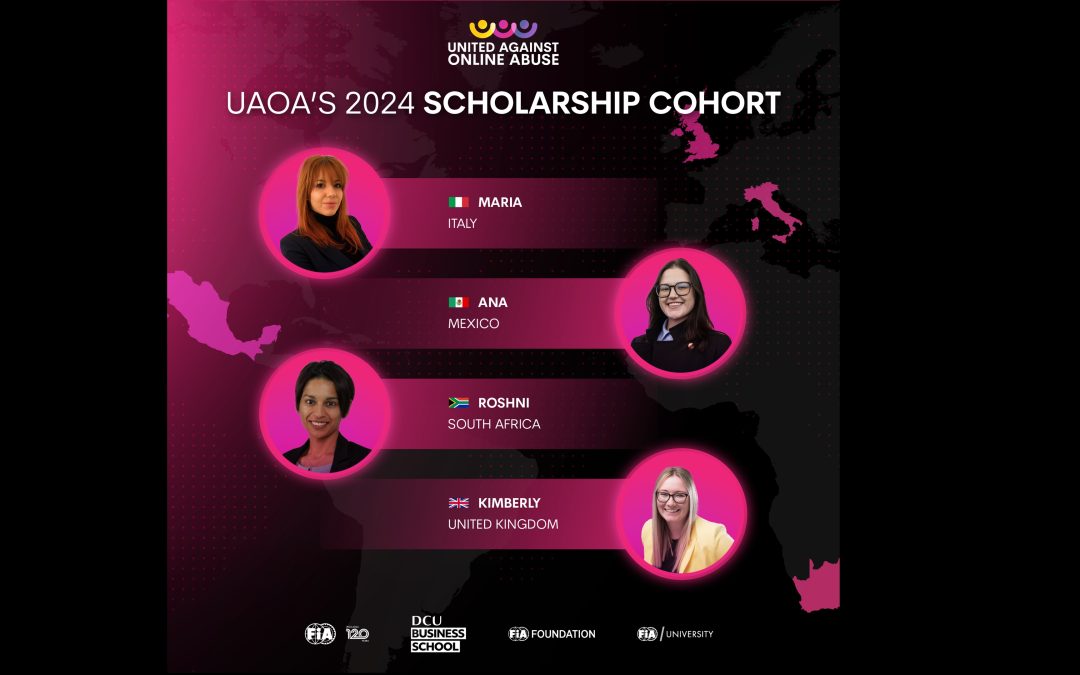
In another proud moment for South African motorsport, Roshni Gajjar from Gqeberha, has been announced as one of the first four recipients of the prestigious Global Research Scholarship, awarded by the FIA in support of its United Against Online Abuse (UAOA) campaign.
The four scholars selected will carry out Masters by Research Programmes at Dublin College University with full funding from the FIA Foundation. Their work will help to improve understanding of online abuse against athletes and officials, providing a strong basis for the UAOA coalition’s ongoing efforts to drive behavioural and regulatory change.
Gajjar will join Ana Rodriguez Armendariz (Mexico), a Deputy CMO at the F1 Mexico City Grand Prix; Kimberley Wyllie (Scotland), managing editor of the Women in a Man’s Race Magazine and active participant in the UK Girls on Track programme and Maria Luliano (Italy) who works as a press officer at Italian motor sport governing body, ACI Sport SpA.
All four are established researchers within their respective fields and bring a wealth of knowledge and experience to the UAOA Research Centre.
FIA President and Founding Partner of UAOA, Mohammed Ben Sulayem, came out strongly last year against the unacceptable levels of online abuse which are creating a blight on the sport. He believes the level of sustained toxicity has reached crisis point and it is time to take a stand. “I am delighted to welcome our diverse scholarship group. United Against Online Abuse is a knowledge-led campaign, which puts research and insights at the heart of all its activities. Our scholars’ research will be key in helping us build a strong knowledge base in this historically under-researched area,” he says.
The UAOA Research Centre is partnered with the FIA University programme which promotes knowledge and research sharing across the international FIA network. The Research Centre is committed to driving inclusive global scholarships, which upskills researchers from around the world, particularly those outside the EU.
Principal Investigator for UAOA, Professor David Hassan, says, “I would like to congratulate Kimberly, Ana, Roshni, and Maria for this exceptional achievement. We are looking forward to working with them, and learning from their unique perspectives, knowledge, and experience on the topic.”
Motorsport South Africa (MSA) is one of 243 Member Clubs. MSA Chairman and FIA Senate member, Anton Roux praised Gajjar on the work she has already done in the industry and the potential contribution her research offers to mitigate online abuse. He said she had the full support of MSA. “Marshals and officials of the sport need to be applauded rather than subjected to any kind of hate speech on social channels so this initiative is to be applauded. The research will enable us to build a greater understanding of the psychological effects of online abuse and inform our strategic approach to tackling the problem in future and protecting participants from this kind of abuse.”
The research will be conducted over two years, commencing this month, through the Dublin City University Business School. The scholarship recipients aim to achieve a Masters by Research (MPhil) on successful completion.
Gajjar, a chartered accountant and strategy consultant, is a strong proponent of positive, purpose-driven success and integrates her philosophy of “Lift as we Rise” into her consulting and performance coaching work which supports STEM career development in motorsport. This closely aligns with MSA’s related objectives.
Commenting on the scholarships, she says she is honoured and humbled to receive the FIA scholarship award and feels extremely privileged to be part of this game-changing research initiative.
“Online abuse deters people from participating, as it infringes on their human rights and compromises the psychological safety of victims, especially women and young people who are avid social media users. Athletes, officials and volunteers will leave if nothing is done. Sport fuels passion and exercises potential. This opportunity presents a unique privilege to give back; to play my part in the global move to combat online abuse. I hope to make a positive difference,” she says.
Adrian Scholtz, MSA Chief Executive Officer, says Gajjar’s selection will add a South African perspective to the FIA’s UAOA global initiative. “We are also highly supportive that the FIA has selected four women. It is commendable that the FIA has initiated this research to develop evidence-based information to steer online abuse combat strategies. Online abuse goes against the spirit of fair play and has no place in sport.”
Some fast facts:
• It is not just athletes that receive abuse. Fans, coaches, commentators, journalists, referees, sporting administrators, among other stakeholders, also regularly receive online abuse as a result of their involvement in the
sporting context
• Ethnic minorities are far more likely to be targeted by, and exposed to, online abuse
• Appearance is the leading cause of online abuse for teenagers and females, being responsible for 38% of such incidents
• About 28% of children around the world have experienced cyberbullying that is racially motivated
• In the 2019/2020 Premier League season, the Professional Footballers Association found that 43% of EPL players had ‘experienced targeted and explicitly racist abuse on public Twitter’
• During the 2022 World Championships, female athletes received 60% of all
online abuse via Twitter and Instagram
• 19,636 posts confirmed as abusive, discriminatory or threatening have been
reported to platforms during FIFA WORLD CUP QATAR 2022
• The ‘United Against Online Abuse’ campaign (UAOA), pioneered by FIA President Mohammed Ben Sulayem, is a research-led coalition aiming to tackle the growing epidemic of online abuse and hate speech in sport.
Prepared on behalf of MSA by Cathy Findlay PR
Roshni Gajjar speaks to Mark Gallagher, an experienced executive, analyst and media specialist who works with top teams and decision-makers in Formula One and in business.